Plaster application
Disclaimer
These guidelines have been produced to guide clinical decision making for the medical, nursing and allied health staff of Perth Children’s Hospital. They are not strict protocols, and they do not replace the judgement of a senior clinician. Clinical common-sense should be applied at all times. These clinical guidelines should never be relied on as a substitute for proper assessment with respect to the particular circumstances of each case and the needs of each patient. Clinicians should also consider the local skill level available and their local area policies before following any guideline.
Read the full PCH Emergency Department disclaimer.
|
Aim
To guide PCH ED staff in the application of plaster backslabs in the Emergency Department (ED).
Procedure for plaster backslab application
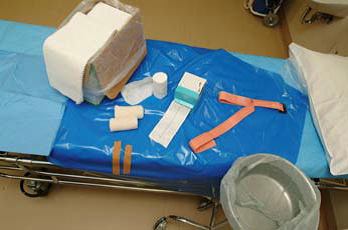
Prepare equipment
- Protective sheet (to place over patient)
- Water bowl with plastic lining
- Plaster slab
- Crepe bandage x 2
- Tape to fasten
- Stockinet and padding
- Sling/collar and cuff/crutches
Measure and cut stockinet (Tubinet® or Tubon)
- Never use Tubigrip® due to excessive compression
- Prevents rubbing and conducts perspiration
- Allow extra length for rolling over end of slab
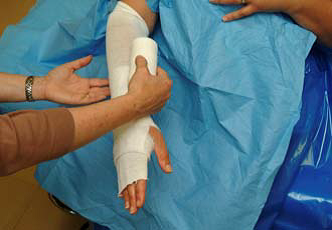
Apply padding (e.g. Webril®)
- Commence distally and roll evenly in a proximal direction overlapping by one-third
- Avoid bunching up of padding by tearing around joints
- Apply extra layers over prominent points
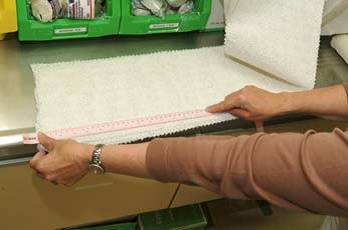
Measure and trim plaster slab
- Basic slab is 10 layers of plaster (i.e. 5 sheets measured to length and doubled over)
Below Elbow Slab/Above Elbow Slab
- use 20 cm plaster for BIG arms
- use 15 cm plaster for SMALL arms
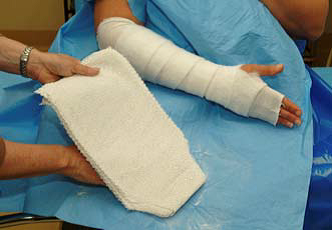
Below Knee Slab/Above Knee Slab
- back slab plus 5 layers for stirrups x 2
- use 20 cm plaster for back slab and 10 cm plaster for stirrups for big leg
- use 15 cm plaster for back slab and 10 cm for stirrups for small leg
- use 15 cm plaster for back slab and 5 cm for stirrups for baby
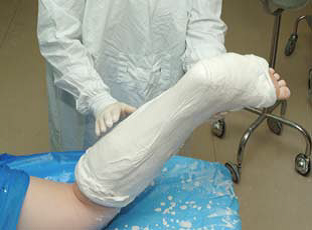
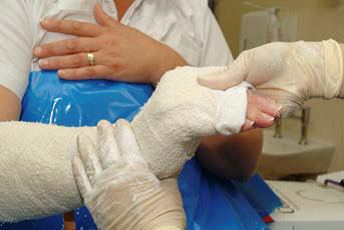
Gutter Splint
- use 15 cm plaster for big arm
- use 10 cm plaster for small arms
| Endorsed by: |
Emergency Department Guidelines team |
Date: |
March 2025 |
This document can be made available in alternative formats on request for a person with a disability.